Our vision · the plan
The plan: from finding land to a living village
Where we're looking, what the land must offer, how we might buy it, how the village could grow and what it could cost. Written for landowners, town halls and partners. All budgets and dates are estimates.
All budgets, timelines and goals on this page are illustrative.
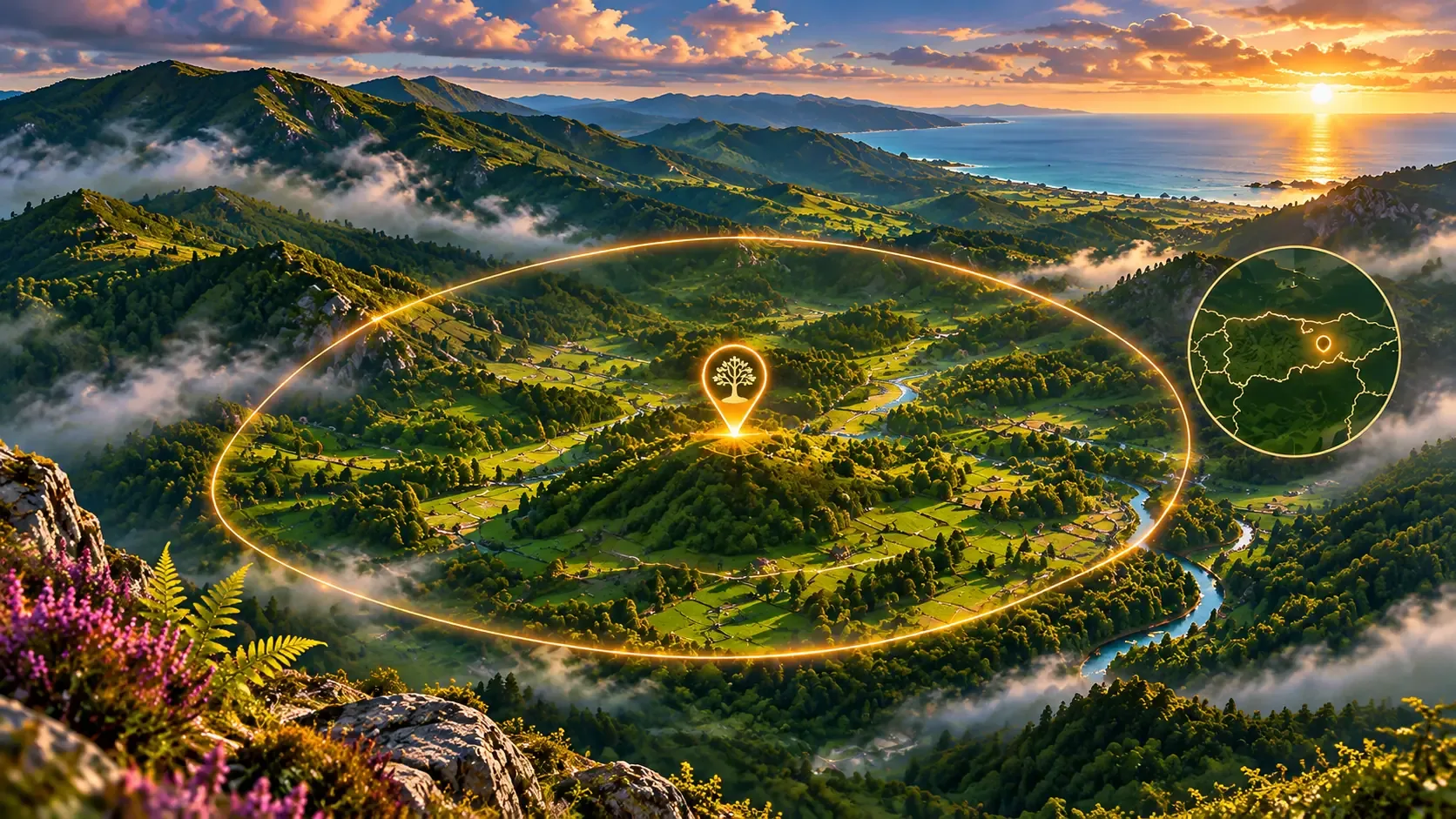
Tierra Luma Vision · the search area, illustrated. Not a chosen site.
At a glance
- Where we're looking
- Eastern Piloña and rural Parres
- Where we are
- Search for land
- 2 / 9 · Now
- Land bought
- None yet
- Starting scenario
- €100,000
- A scenario, not a budget
Where we are looking
Search areas, not a site. No property has been chosen or bought. We favour a beautiful, peaceful place near activities over the busiest tourist town: ideally 10–20 minutes from Arriondas or Infiesto and about 30–40 minutes from the coast.
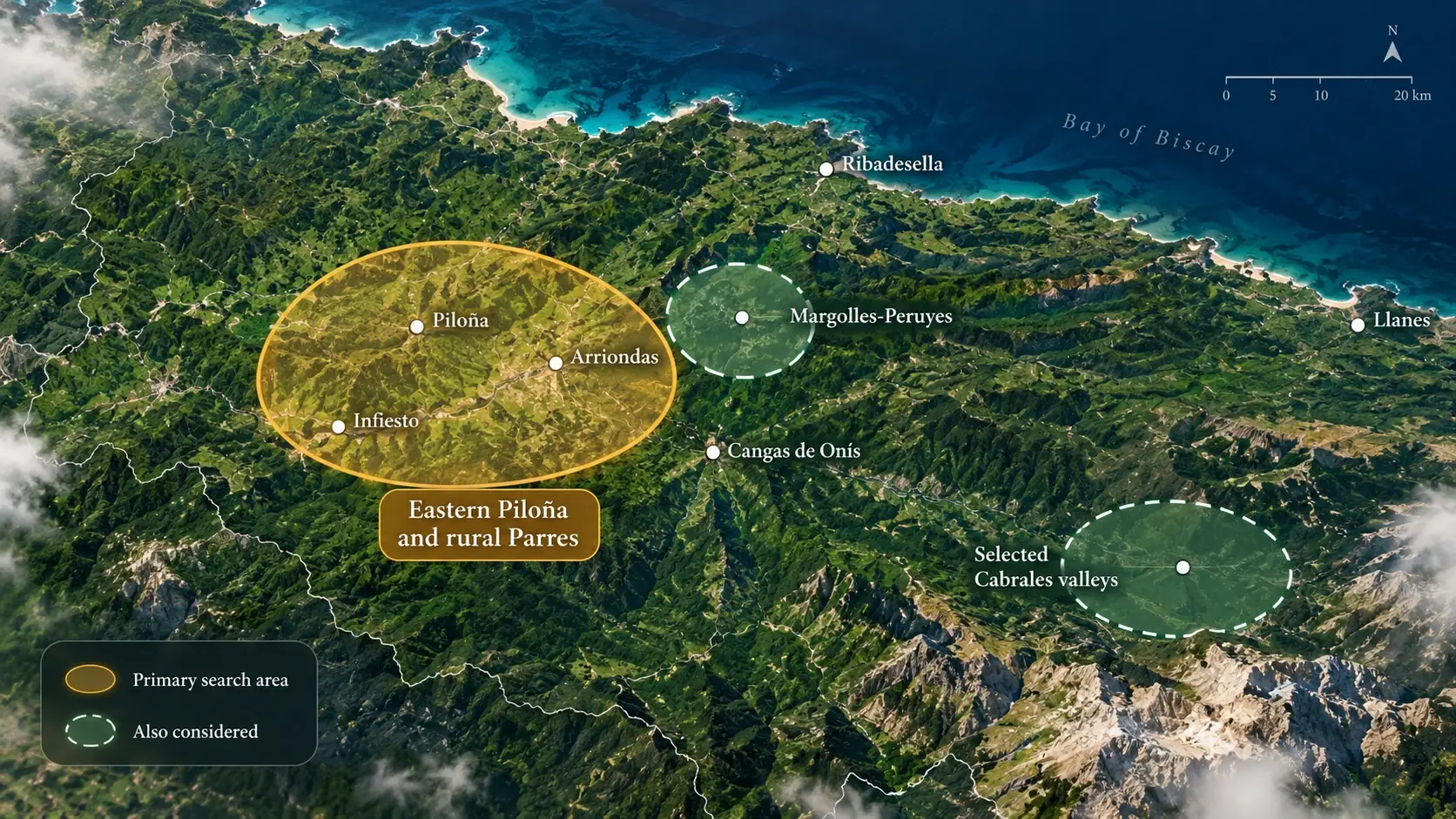
Show the detailed map of the search areas
Primary search area
Eastern Piloña and rural Parres. The first choice: the valleys around Villamayor, Sevares, Fíos and Bode, between Infiesto and Arriondas. They lie close to year-round towns, the Sella and the Picos, and 30–40 minutes from the coast.
Also considered
- Margolles–Peruyes. Between Arriondas and Cangas de Onís, on the way to the coast.
- Selected Cabrales valleys. At the foot of the Picos de Europa, around Arenas de Cabrales.
- Inland Ribadesella. The rural valleys behind the coast. Not drawn on the map: no reliable outline was found.Described in words only
Indicative outline drawn around documented villages, not a property boundary. Villamayor (Piloña) · Sevares (Piloña) · Fíos (Parres) · Arriondas (Parres) · Margolles (Cangas de Onís) · Arenas de Cabrales
Finding the right land
What the land must offer, how we might buy it, and what is checked before any offer.
What makes a property right
Legal and usable
Habitable buildings with a lawful status and a viable path to welcoming guests: ideally one that already has, or can clearly obtain, a tourism use.
Atmosphere
Privacy, forests, valleys and nature close at hand.
Life nearby
Year-round towns, services, visitors and partners within reach.
Affordable in full
A total cost that still works after taxes, repairs and reserves.
Room to grow
Realistic chances to buy or lease next door, ideally discussed with the owners before buying.
How we might buy
Illustrative strategies from our planning. These are not offers, valuations or a chosen property.
Option A
One larger farm
A farm of 3–5 ha with outbuildings, if one appears within budget, could be excellent.
- For
- Everything in one place from the start
- Against
- Purchase and repairs can consume the whole budget
- Agricultural land may not allow tourist accommodation
Option B
Several smaller properties over time
Buy one small property now and add others as uses, permits and funding become clear.
- For
- Limits the first commitment
- Against
- Taxes and fees on every purchase
- Utilities and access can be fragmented
Preferred
A hybrid
A compact traditional casería or quintana with a legal house, one or two outbuildings and perhaps 2,000–5,000 m² of land, with nearby room to grow. If a good larger farm appears, choose it instead.
- For
- Affordable start with real potential nearby
- Against
- Depends on finding the right neighbours over time
Buy what we can legally use today; pay extra for future potential only when it can be verified.
- Separate plots do not automatically form one approved tourist complex.
- Owning agricultural or forest land does not grant building rights.
- A cheap ruin or an abandoned village can cost far more to make legal and usable than a habitable house.
- Building or rebuilding without the right permission can end in fines or demolition.
- Accommodation, barn conversions, camping, treehouses, events and wellness installations each need written approval first.
The checks before any offer
Restore before building new. A local architect and lawyer verify each point in writing before any offer.
Legal
- Land classification
- Lawful status of every building
- Renovation and change-of-use rights
- The exact tourism classification possible
- Written municipal guidance before relying on any new use
- Outdoor gatherings: municipal authorisation, capacity and noise limits
- Film screenings and music: public performance licences
Access and services
- Road access
- Water, power and connectivity
- Wastewater
Nature and risk
- Protected areas and species
- Flood risk
- Wildfire season, quiet hours and wildlife near any gathering
- Children's activities and river outings: supervision, insurance and licensed providers only
- A baseline of soil, water, plants and wildlife
How the village could grow
Illustrative timeline. Every step depends on the right property, permits and funding. Permits alone can take a year or two, and a place like this usually needs several years before it pays its own way; each step starts only once the one before it works.
NowSearch and checkWe are here
- Explore the search areas
- Legal and ecological checks before any offer
- Keep growing the travel guide and trip planner
Year 1A home that works
- Buy a legally habitable home
- Services and essential improvements
- First gardens
- Record a baseline of soil, water and wildlife before changing anything
Luma House
Year 2Test and welcome
- Test small experiences, courses and longer stays with local partners
- First approved guest accommodation, if feasible
Luma StaysLuma Farm
Years 3–4A second piece
- Acquire or lease an extra cottage or parcel, only once the first steps work
- More growing and more experiences
Luma StaysLuma FarmLuma Forest
Years 5–7Steady and approved
- Returning guests and a sound business
- Approved accommodation and some help
- A yearly public report on the land and the community
Luma StaysLuma Wellness & Community
Years 7–10A living village
- Financial resilience
- Only selective expansion
- Time protected for family and nature
Luma HouseLuma StaysLuma FarmLuma ForestLuma Wellness & Community
A €100,000 starting scenario
Only a scenario: planning assumptions to test what a first purchase could look like. It is not a budget, a quote or a valuation. Living-cost reserves and another source of income are kept outside it.
Starting scenario in total
€100,000
| House | €60,000 | 60% |
|---|---|---|
| Purchase costs and taxes | €7,500 | 7.5% |
| Essential improvements | €16,000 | 16% |
| Gardens and basic amenities | €4,000 | 4% |
| Architect, lawyer and permits | €5,000 | 5% |
| Cash reserve | €7,500 | 7.5% |
| Total | €100,000 |
Over time income could come from several small streams (stays, experiences, workshops, food) rather than one.
Possible income
- Accommodation
- Guided experiences and outdoor activities
- Workshops, education and retreats
- Farm-to-table meals and events
- Hire of outdoor spaces for small private gatherings
- Places at small gatherings and workshops
- Memberships and gift cards
- Products made on the land
Funding options being researched
- The founders' own capital
- Income from future organised adventures with local partners
- Bank financing
- Partners or investors aligned with the vision
- Public rural-development and environmental programmes
None of these has been applied for or agreed.
Key uncertainties
| Finding the right land at a workable price | A clear list of requirements and a patient search. |
|---|---|
| What planning rules allow on rural land | Check before buying, with a local planning consultant. |
| Water rights | Confirm with the river basin authority before committing. |
| Building costs and timing | Restore existing buildings first; build in small phases. |
| Seasonality of visitors | Year-round programmes: education, workshops, food. |
| Financing | A phased plan so each step can stand on its own. |
Where the project stands
Tierra Luma is a plan in development. We are looking for land in eastern Asturias, and no adventures are organised yet. Nothing has been bought or built, and nothing can be booked yet.
Being researched
- Suitable land and locations in eastern Asturias
- Planning, tourism and water regulations
- Funding options
Under development
- The concept and this project presentation
Planned
- Phases 1 to 4 of the development plan
Completed
- A first public website: a guide to the places of Asturias and nearby provinces, each with its sources
Project updates
The guide grows to eight provinces
Tierra Luma's guide now covers eight provinces of northern Spain, with festivals of tourist interest, local services, suggested trips and a planner that keeps your trips on your device. The vision page now explains how journeys, a future place and the land could support one another. The search for land continues; no property has been chosen or bought.
The plan is public, on tierraluma.com
The website moved to its own address with a new design and the official logo. It now sets out the Vision and Plan in full: grow a village, not a resort; the five Luma elements; where we are looking (eastern Piloña and rural Parres first); how we might buy; and what is checked before any offer. No property has been chosen or bought.
1 earlier updates
The Tierra Luma atlas goes live
The first version of this platform: 25 checked places in eastern Asturias, a journey planner and this journal. The search for land has not yet produced a property.
Still to decide
What the plan leaves open today. If you can help with one of these, we would love to hear from you.
Where, and how big
No land has been chosen, so there is no site plan, no number of cottages or beds and no area for each part. The aim is a size the land and the valley can carry: fewer visitors, staying longer.
Energy
Renewable where possible: which system, how it is stored and how the buildings are heated is still open.
Water and wastewater
Where the water comes from, the rights to use it and how wastewater is treated depend on the land and the authorities.
Who runs it
Hiring locally wherever possible is the intention; the team, the roles and how decisions are made are still to be shaped, with clear rules for decisions and disagreements before anyone else joins. A non-profit association beside the business could open partnerships with public programmes and local groups.
Getting there and around
Fewer cars and public transport are the aim; parking and access depend on the place.
Animals and grazing
A few hens and bees are named; which other animals, and how meadows are grazed, is not yet decided.
The seasons
What happens in each season of the year is named but not yet worked out.
Safety and access for all
Insurance, emergency access and step-free access are on the checklist, not yet answered.
How much goes back to the land
That a fixed part of what the place earns goes to the land and the forest, set aside before anything else, is an intention; how much is not set.
Questions
Words you'll meet
Buying and building in Spain comes with its own vocabulary. A few words, in plain language.
- Casería
- The traditional Asturian farmstead: a family's house, outbuildings such as the hórreo and the stable, and the land worked around them.
- Hórreo
- A granary raised on stone pillars, typical of Asturias; many are protected as heritage.
- NIE
- The identification number a foreigner needs to buy property in Spain.
- Nota simple
- An extract from the Land Registry showing who owns a property and the charges on it, such as mortgages or rights of way.
- Source: Registradores de España
- Catastro
- The state register that describes each plot (boundaries, area and use) for tax purposes. It does not always match the Land Registry.
- Source: Sede Electrónica del Catastro
- Contrato de arras
- A private contract with a deposit that reserves a purchase before the deed is signed.
- Suelo no urbanizable
- Land the municipal plan keeps out of urban development. What may be built on it is limited and depends on its category; in Asturias, the núcleo rural category covers traditional rural settlements.
- Source: Gobierno del Principado de Asturias
- Licencia de obras
- The building permit granted by the town hall (ayuntamiento).
- Confederación Hidrográfica del Cantábrico
- The river basin authority that grants the right to use water from rivers, streams and springs in most of Asturias.
- Source: Confederación Hidrográfica del Cantábrico
Have you bought land?
No. The search is under way in eastern Asturias and no land has been acquired yet. When that changes, it will be recorded in the progress journal.
When will it open?
No dates are promised until they are real. Finding, checking and buying land, studying it and getting permission each take their own time, and the plan grows only as fast as the land allows.
Will there be a lot of building?
No. A handful of small, low-impact buildings, only after the land work has begun and only where the planning rules allow it.
I know of land for sale. Can I tell you?
Yes, please. Use the contact form on this page and choose “Land that might fit”. Every message is read, and nothing you send is published.
How would Tierra Luma pay for itself?
With several small activities that support each other, not one big one: a few stays in restored houses, longer stays and courses with local partners, food from the gardens, and days out run by local guides. A fixed part of what comes in would be set aside for the land before anything else, with a reserve for lean years. Places like this usually need several years before they pay their own way, so the plan grows only as fast as it can afford. No figures are published until they are real.
Won't more visitors harm the valley?
Not if it stays small enough to keep its magic: fewer guests who stay longer, rather than many passing through. Neighbours' homes should stay homes, local guides and producers come first, quiet hours and wildlife are protected, and the people who live there would have a real say in how the place grows.
Why start so small?
Because the most beautiful places grow slowly, from strong roots. Starting with one home and its garden lets the land, the neighbours and the project get to know each other, and each next step grows once the last one is thriving. It is also the wiser way: places that rush, buy ruins or build without permission rarely last.
Do I have to share your way of life to take part?
No. There is no single right way to live, and Tierra Luma will never ask anyone to adopt one. You can visit, learn something, share a skill, help on a planting day, partner as a local business, or simply follow along. Take what fits you. The only shared agreements would be the few that keep people, the land and the neighbours safe and respected.
How would it be organised?
Probably in two parts: a small business for stays and food, and a non-profit association for learning, culture and work with local groups and public programmes. Clear rules for decisions and for disagreements would come before anyone else joins, and the intention is to publish what the land and the community gain each year, setbacks included. The exact legal form will be chosen with advice.
Can I stay at Tierra Luma or book something?
Not yet. There is no accommodation, no activity and nothing to book. When that changes, it will be announced here and in the progress journal, and never before it is real.
Where will it be?
Somewhere in eastern Asturias, within reach of the Picos de Europa and the sea. No land has been acquired yet, so there is no address.
What can I do here today?
Explore the places of Asturias and nearby provinces, each with its sources, plan a trip in My trips, read the journal and our story, and follow the project updates.
Does Tierra Luma organise trips or adventures?
Not yet. The suggested trips on this site are self-guided: you plan, book and travel on your own, and Tierra Luma sells nothing. In the future we hope to offer organised adventures with qualified local guides and outfitters, which could help fund the first Tierra Luma place. They will be announced in the project updates only once they are real.
Is this a hotel or an eco-resort?
No. Places to stay are one small part of the plan. The heart of it is restoring land, growing food and sharing it, with learning, adventure and community around that.
How will you know it is really regenerative?
By measuring before claiming. The plan is to record a baseline (soils, water, plants and wildlife) before changing anything, then publish methods and results over time. Until there are results, there are no claims.
Can I help, collaborate or support?
Yes. The most useful thing today is to follow along and share knowledge: ecologists, growers, builders, educators, guides and people from the area are especially welcome. There is no public fundraising or investment offer; partners who would like to talk about the plan can write to us.
Talk to us about Tierra Luma
Who we'd like to hear from
- Landowners
- Land or a farmstead that might fit the requirements
- Town halls and the regional government
- What the rules allow and how to do it well
- Architects and planners
- Feasibility, design and permits
- Farmers, producers and guides
- Working together from the start
- Experience hosts, artists and educators
- Ideas for workshops, walks or evenings you could lead one day
- Families, teachers and local schools
- What you would love children to discover outdoors, so future learning is shaped with you
- Community organisers and future volunteers
- Picnics, language exchanges or planting days you would love to join or run, once there is a place
- Environmental organisations
- Restoration methods and monitoring
- Financing partners
- A phased, transparent plan