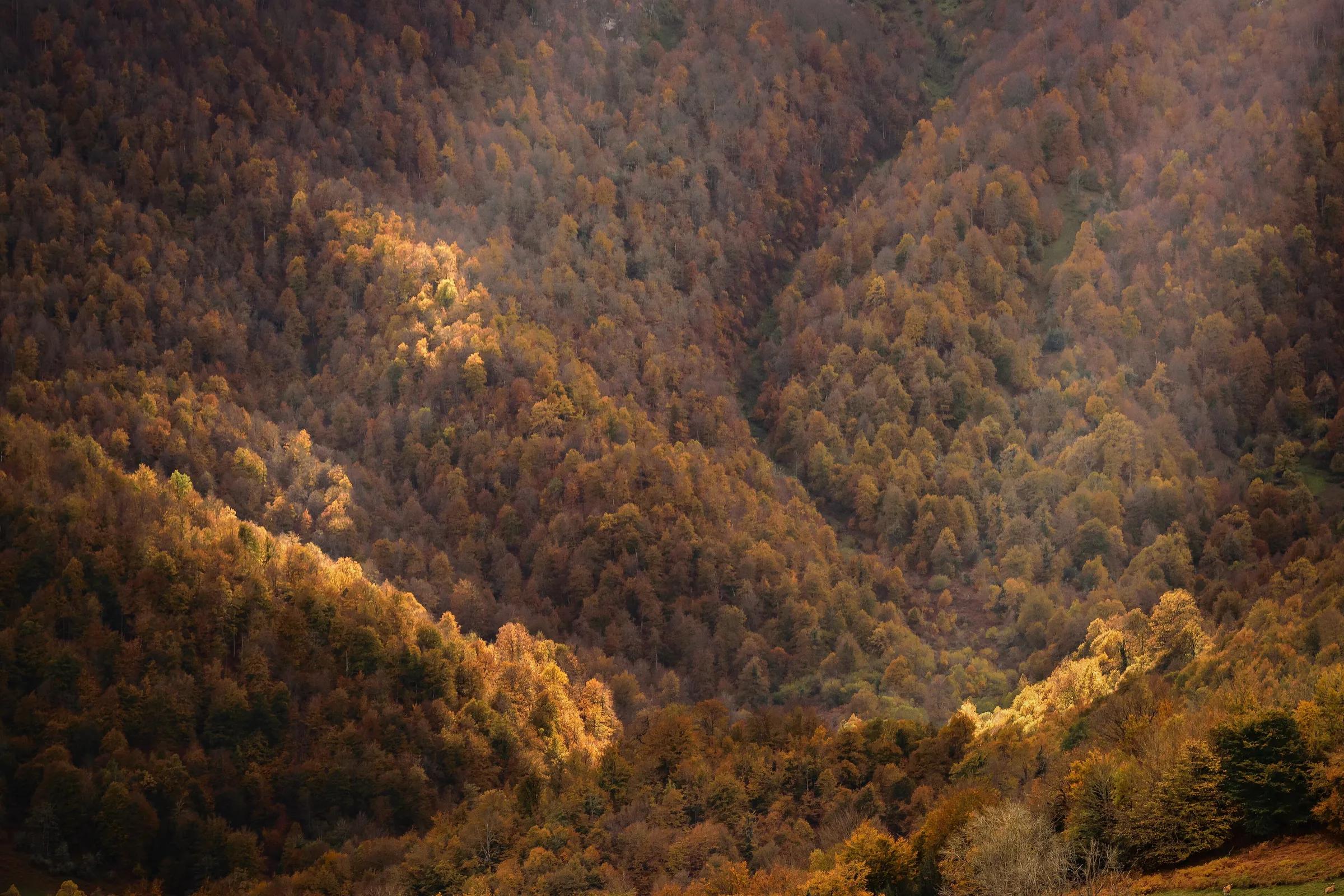
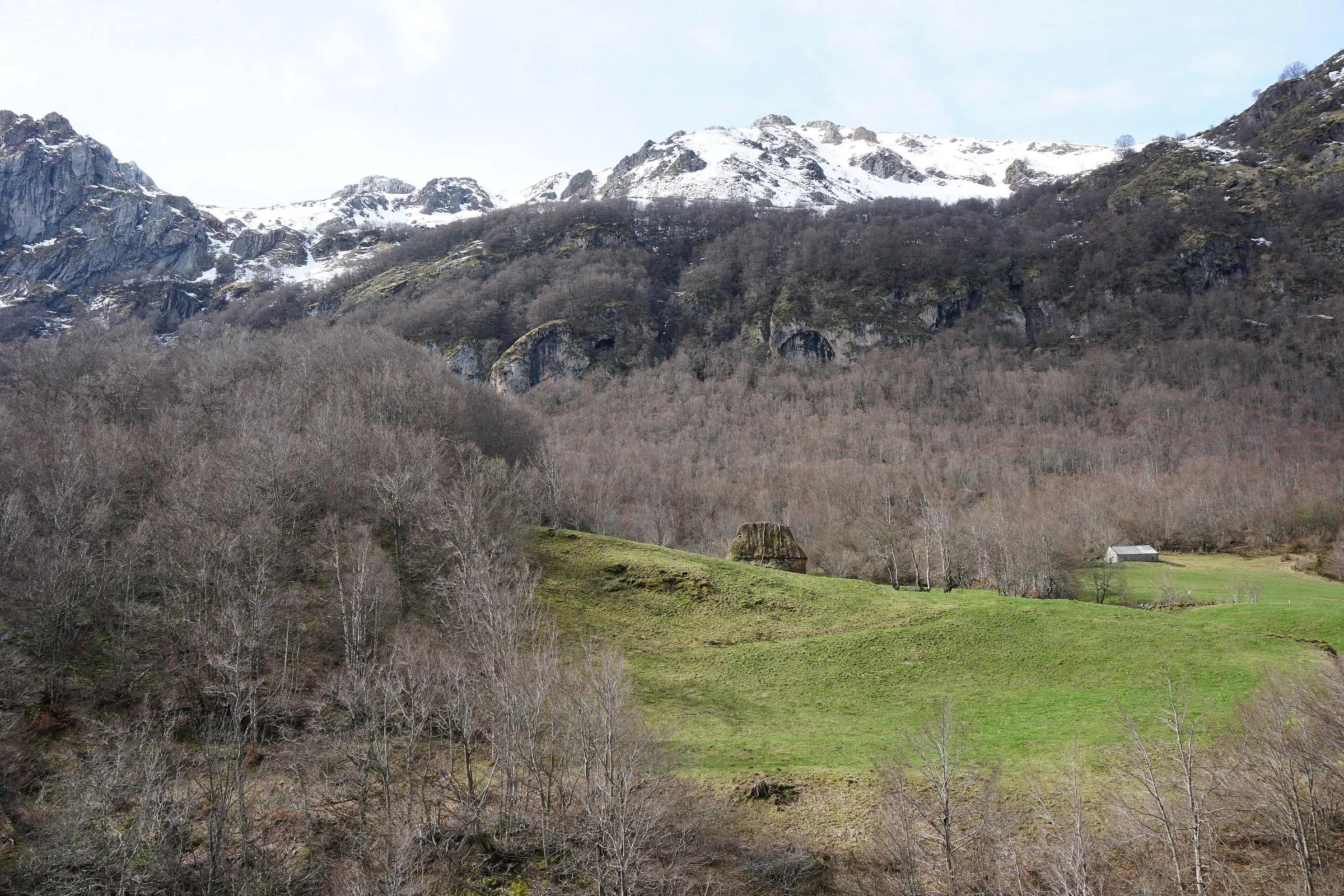
 Tanja Freibott / Wikimedia Commons, CC BY-SA 4.0
Nature & Wildlife · Nature & wildlife
Brown bears of the Cantabrian Mountains
Brought back from the edge in a single human lifetime, the Cantabrian brown bear now roams from Asturias to Palencia. How it lives through the year, how to watch it without being felt, and what keeps it here.
First light comes slowly to the high valleys of Somiedo. It finds the limestone first, then the pale scree, then the long slopes of broom and grass that fall towards the beech woods. Somewhere on that slope, a dark shape that looked like a boulder a moment ago lifts its head and begins, unhurriedly, to graze. Watching it through a telescope from the far side of the valley, you are seeing one of the quieter conservation stories in Europe: an animal that was close to vanishing from these mountains within living memory, and is now a neighbour again.
A bear that came back
The Cantabrian brown bear (Ursus arctos) lives across Asturias, the provinces of León and Palencia in Castilla y León, Cantabria and a small corner of Lugo in Galicia. According to the Fundación Oso Pardo, the population shrank until the end of the twentieth century; in the mid-1990s it began a recovery that continues today. Turismo Asturias puts the low point at around eighty bears in the 1970s and 1980s.
For decades the population was followed by counting females with cubs of the year, a standardised census run since 1989 by the Fundación Oso Pardo and the regional governments. That series shows growth of around ten per cent a year over the last quarter of a century. The counts are now giving way to genetic estimates from droppings and hair: about 324 bears from the studies of 2017 and 2019, and, in 2020, a genetic estimate by the regional governments of about 370 bears. That 2020 figure is the most recent overall estimate the foundation publishes. The bears are permanently present over some 8,600 square kilometres, with a growing fringe of occasional visits beyond.
Two subpopulations, slowly joining
The Cantabrian bears form two subpopulations, western and eastern. Until the start of this century they were almost completely isolated from each other, with no exchange of genes. As numbers rose, contact returned: in 2008 the first 'hybrid' bears, with a western father and an eastern mother, were detected in the east, and today males seem to move between the two regularly. Females tend to settle close to where they were born, and none has been found crossing the corridor naturally, so the foundation still speaks of two distinct breeding nuclei.
The difference in size is large. In 2018, the last year in which females with cubs were published for both, 31 were found in the west and 7 in the east. Two young females found in poor condition in the western nucleus of Asturias have since been rehabilitated in captivity and released in the eastern one; if they survive and breed, it will be one more step in the genetic recovery of the Cantabrian bear.
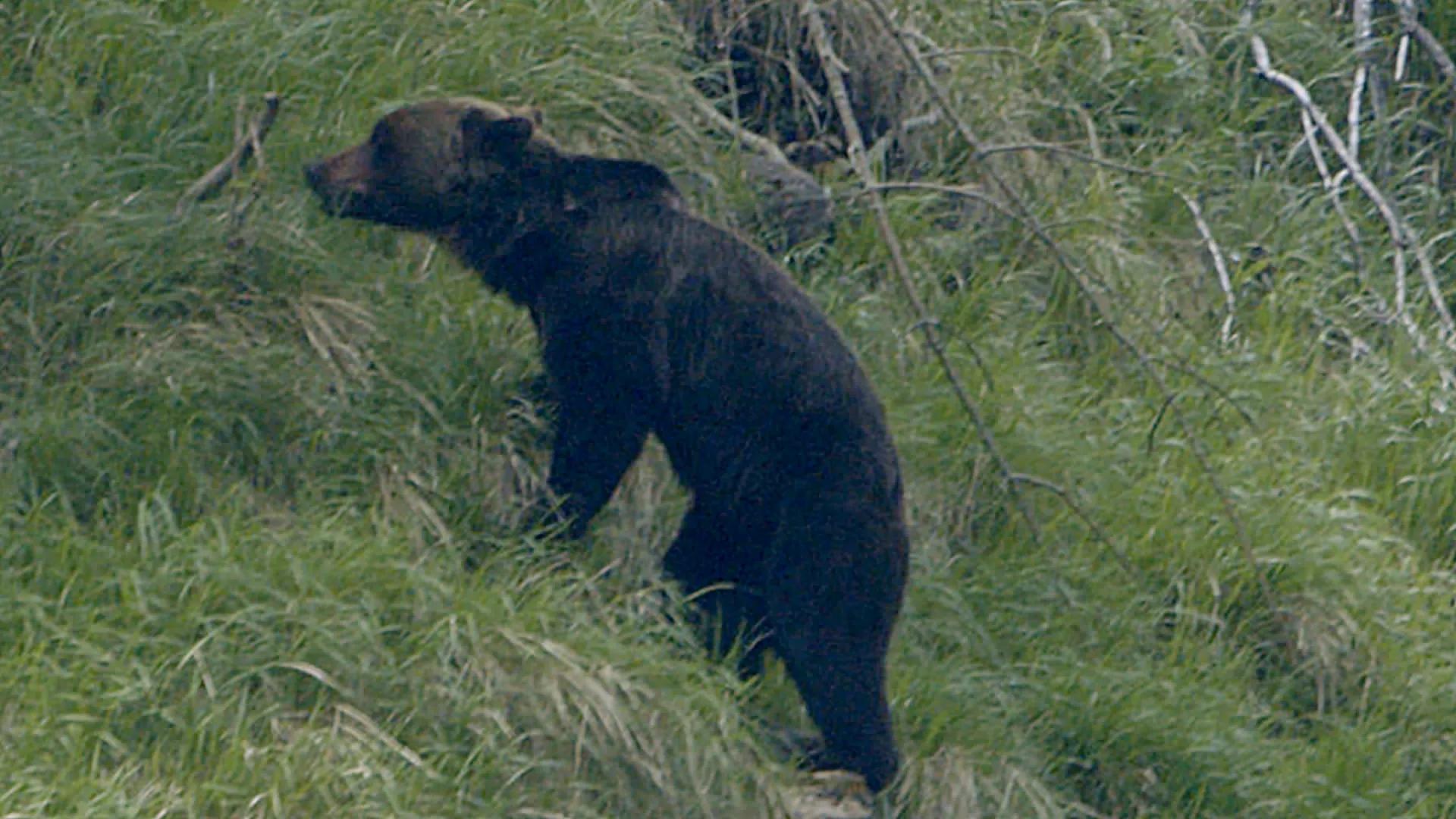
Cantabrian brown bear
Ursus arctos
- Habitat
- Mountain beech and oak woods, scrub and high pastures of the Cantabrian range, from Asturias and León to Palencia and Cantabria.
- When
- Best seen in spring, in April and May, at dawn and dusk; summer is still good; autumn bears keep to the woods.
- Conservation
- Listed as 'in danger of extinction' in the Spanish Catalogue of Threatened Species; a priority species for the European Union.
A year in the life of a bear
Winter is the season of the den. Temperature is one of the triggers for hibernation, and the Fundación Oso Pardo notes that warmer winters mean bears hibernate for less time, or not at all; Turismo Asturias also records that some individuals do not hibernate. Cubs are born in the den, and their first weeks outside it are delicate enough that Spain's national conservation strategy treats places with winter dens, and with females accompanied by very young cubs, as critical areas for the species.
Spring brings the bears into the open. They graze the fresh meadows to recover after the winter pause, and the mating season adds to their movement, which is why April and May are considered the best months to see them. In summer they forage in less wooded places, often around fruit trees. Wild cherries have become an increasingly important food in recent decades, according to research published by the foundation.
Autumn is a race. In the weeks of hyperphagia before hibernation, a bear must eat enormous amounts to build up fat; females need to reach a minimum level of body fat to breed successfully. Beechnuts, acorns, chestnuts and hazelnuts are the energy base of the Cantabrian bear's diet. In this season they are very active but stay inside the woods, which makes them hard to see. A poor year for acorns or beechnuts is felt the following spring, and the foundation is studying how a changing climate may alter the forests that feed them.
Wild cherry
Prunus avium
- Habitat
- Isolated trees or small stands in clearings and at forest edges, where it colonises open ground.
- When
- Flowers at the beginning of spring; its fruit is now an important food for bears building reserves.
Watching without being felt
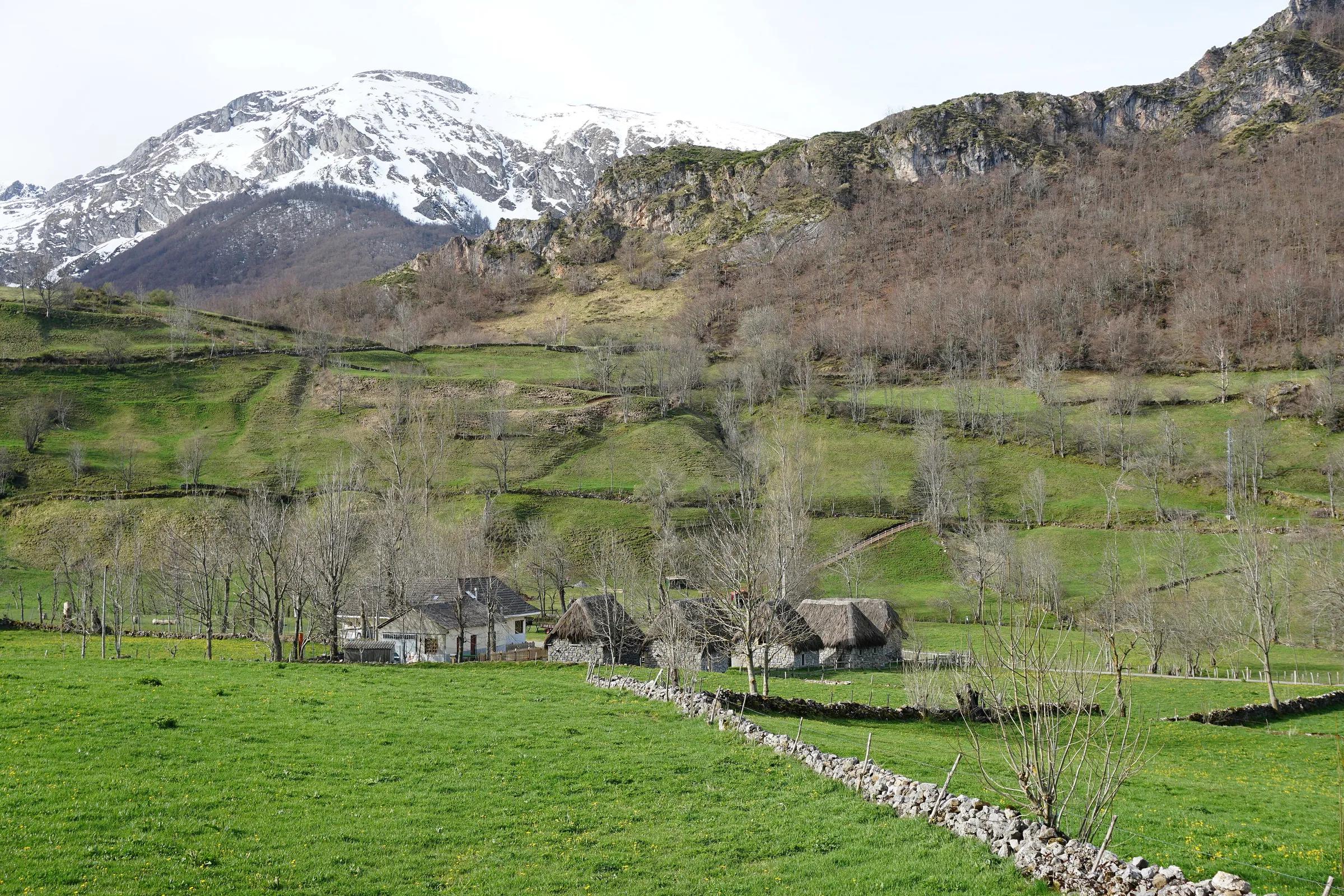
Bear-watching here is an exercise in patience and distance. Turismo Asturias names Somiedo, the Fuentes del Narcea park and the valleys around Proaza among the places to try, with viewpoints such as Gúa and the Mirador del Príncipe at La Peral in Somiedo, and Fonduveigas in Fuentes del Narcea. It recommends going with the local wildlife-watching companies, whose guides choose authorised observation points according to the season and the bears' recent movements, keep a very prudent distance from the animals and bring telescopes and binoculars. Waits are long, and a sighting is never guaranteed.
- Use long optics and keep a safe distance. A bear can turn aggressive in seconds and is very fast over short distances.
- Never follow a bear's tracks: you could surprise it while it feeds or rests.
- Stay on marked paths, and if you leave them, never push into dense vegetation.
- Keep away from carcasses: a bear may be resting nearby and defend them.
- If a bear notices you, make yourself known by speaking softly, without sudden gestures.
- Never feed or bait a bear, and never leave food behind.
That last point matters more than it seems. The official protocol for bears in the Cantabrian range defines a bear 'conditioned by food of human origin' as a problem bear, alongside bears that repeatedly kill livestock and aggressive ones. Some bears have already learned to visit fruit trees and feed close to villages, and the regional governments and the foundation now fit some of them with GPS collars to study and deter them. Every bar of chocolate left at a viewpoint is a small push in that direction.
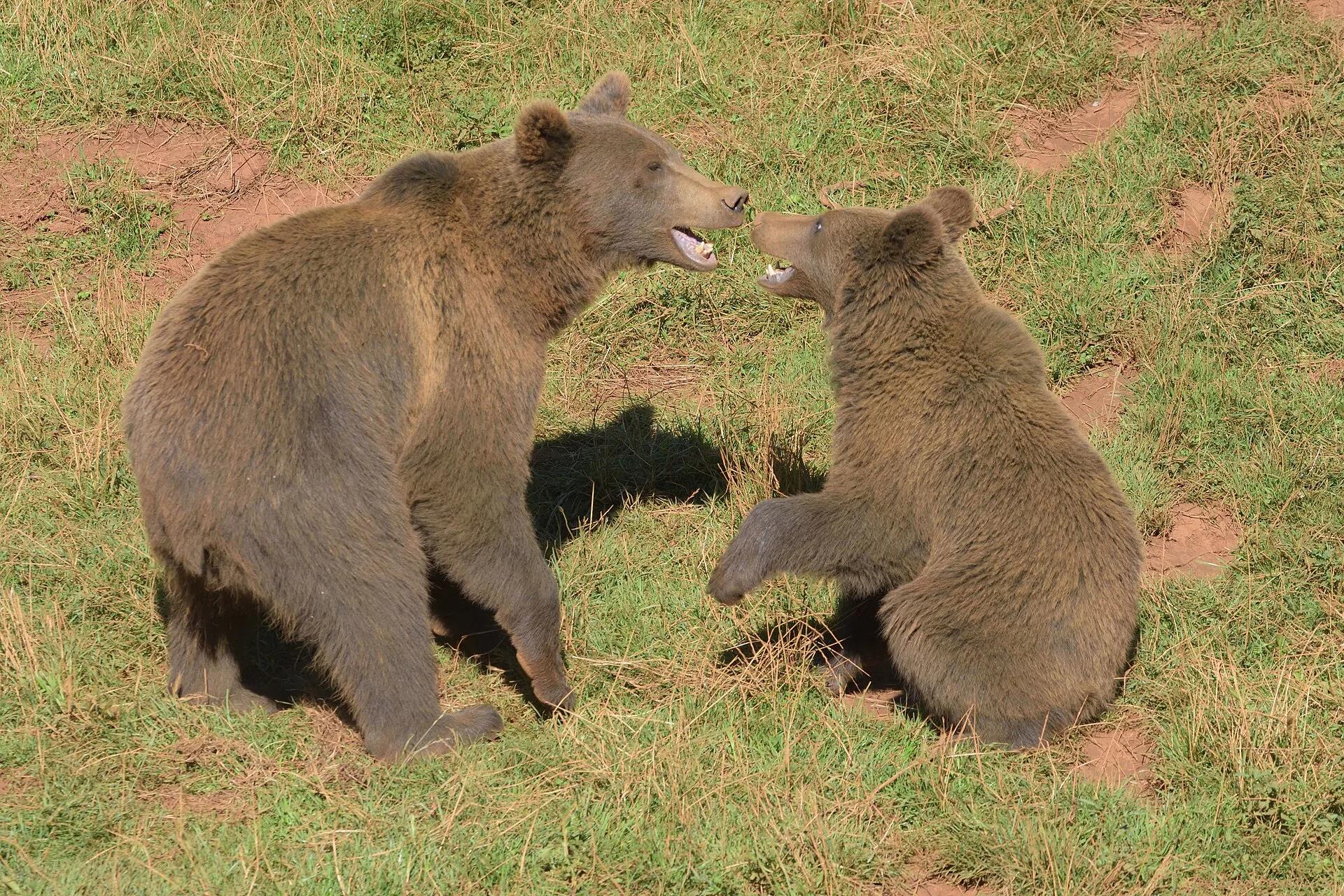
If the mountains keep their bears hidden, there are honest alternatives. On the Senda del Oso near Proaza, bears living in semi-captivity in enclosures can sometimes be seen from the greenway, though, as Turismo Asturias puts it, whether they appear is up to them. Visitor centres across bear country explain the species, and the wider Montaña Palentina, in the east of the range, is also bear country.
What keeps them here
The brown bear is listed as 'in danger of extinction' in the Spanish Catalogue of Threatened Species and is a priority species under the EU Habitats Directive. Its recovery is guided by a national strategy for the Cantabrian range, approved in 2019 to replace that of 1999, and by the recovery plans of each region. The strategy names the threats plainly: residual poaching and poison; the loss and fragmentation of habitat through fires, new roads, quarries and tracks, and the spread of outdoor leisure into good feeding and resting areas; and a rise in conflicts between people and bears as numbers grow.
There is another side to the ledger. A 2025 study by INDUROT and the Fundación Oso Pardo, based on 220 businesses in 68 municipalities of bear country, found that about 30 per cent recognise some economic dependence on the bear, rising sharply among wildlife guides and interpretation services. The bear has become a reason to stay in the mountains as well as a reason to visit them. The best thing a traveller can add to that is restraint: a guide from the valley, a long lens, a quiet voice and an early start.
Practical details checked on 8 November 2026. Rules, access and seasons change. Check the official sources below before you go.
Sources
- Fundación Oso Pardo, Ficha 1: Cuántos osos hay y dónde viven (2026)(in Spanish)checked 8 November 2026
- Fundación Oso Pardo, resúmenes de proyectos MITECO 2024checked 8 November 2026
- Fundación Oso Pardo y AEFONA, Osos y cambio climático: recomendaciones en montes oseroschecked 8 November 2026
- Quercus, especial Fundación Oso Pardo: Ciencia para la conservación del oso cantábrico (julio de 2026)(in Spanish)checked 8 November 2026
- MITECO, Estrategia para la conservación del oso pardo en la cordillera Cantábrica (2019)(in Spanish)checked 8 November 2026
- Turismo Asturias, Los mejores lugares para ver osos en Asturiaschecked 8 November 2026
- Turismo Asturias, Brown bear watching in Asturiaschecked 8 November 2026
Take it further
If this story set you thinking, here is where to take it next.
Series