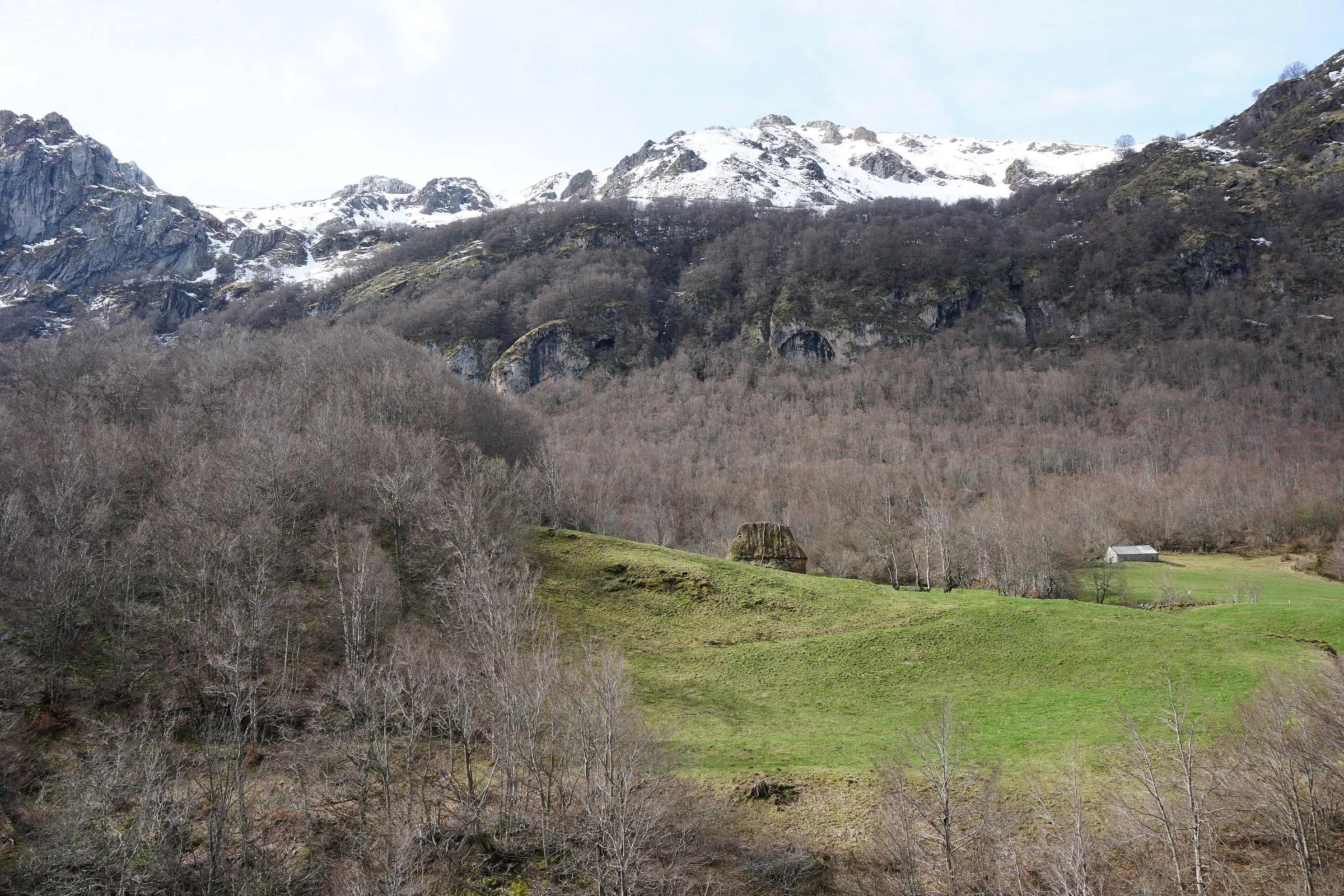
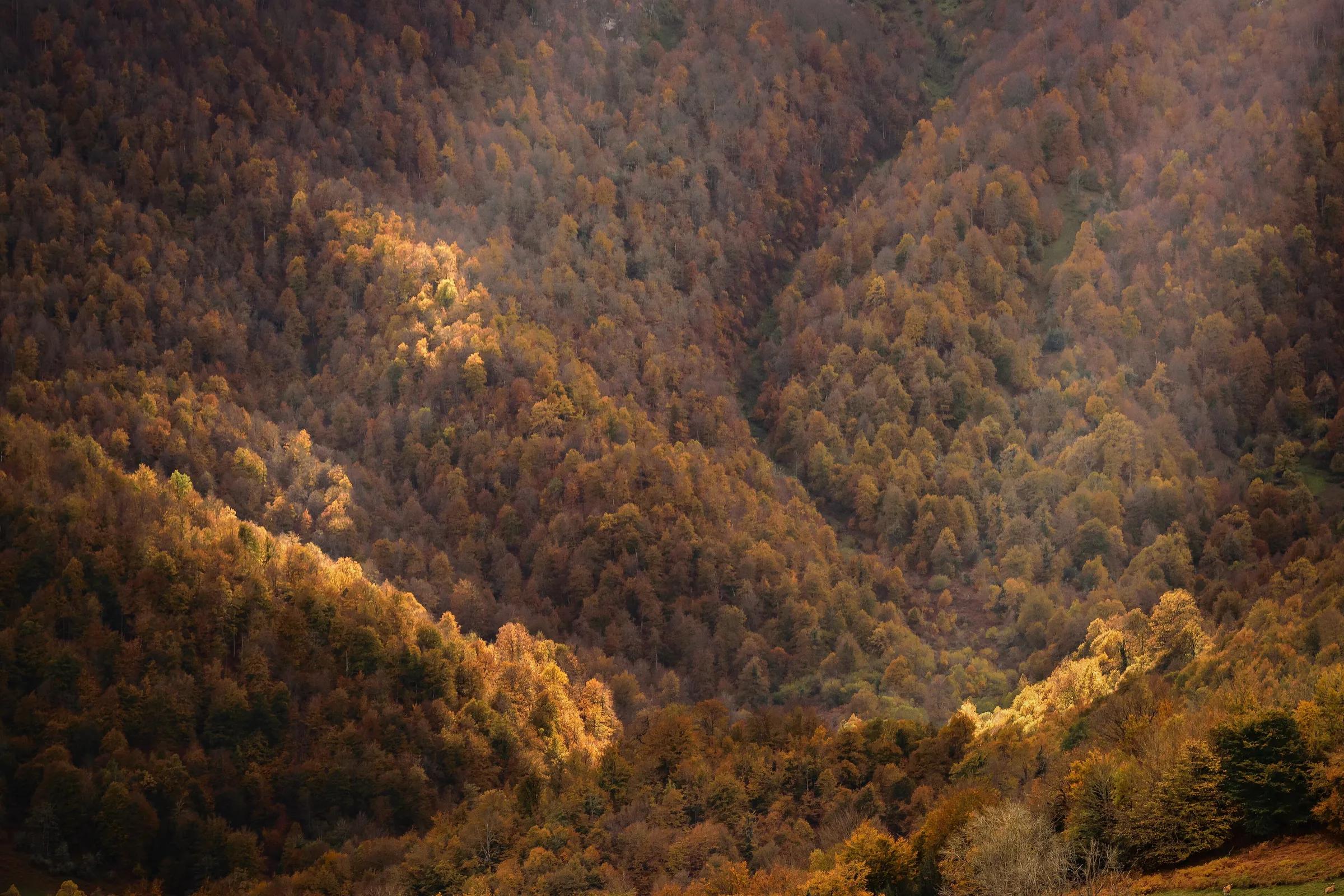
 Teseum / Wikimedia Commons, CC BY-SA 4.0
Nature & Wildlife · Nature & wildlife
Ancient woods of the north
Beech on the mountain passes of Ponga and Redes, oak in the closed valley of Muniellos, a river forest in Galicia: five Atlantic woods, what lives in them and how to walk them lightly.
In late October the beeches of Peloño turn the mountain into a slow fire. Copper and gold run along the slopes above Les Bedules, and under the canopy the light goes green-brown and quiet, filtered through a roof of leaves that has been growing, falling and rotting into the same soil for centuries. Moss climbs the north side of every trunk. A jay calls somewhere out of sight. This is what the north of Spain looks like when it is left to itself: an Atlantic forest, fed by rain off the ocean and held in place by mountains.
Beech country: Peloño and Redes
Turismo Asturias describes Peloño, in the concejo of Ponga, as one of the most extensive and best-preserved beech woods in Asturias. It lies inside the Ponga Natural Park and Biosphere Reserve and the Ponga-Amieva Natura 2000 site. The classic way in is the old Camín de los Arrieros, the muleteers' track, a wide and well-marked path that leaves from the viewpoint of Les Bedules. Among the beeches stand scattered oaks, including the Roblón de Bustiello, a monumental sessile oak, and the route ends at the meadow and chapel of Arcenorio, where gentians grow.
The full route is long, about fourteen kilometres each way and more than five hours in all, but it is an out-and-back track, so you can walk as far as your legs and the light allow and turn round. The official route page asks walkers to keep dogs on a lead, to give livestock a wide berth, never to approach, feed or encourage the mastiffs that guard the herds, and to carry out every scrap of rubbish, organic waste included.
Just west, across the high ground, the Redes Natural Park covers the whole of the concejos of Caso and Sobrescobio. It was declared a natural park in 1996 and a UNESCO Biosphere Reserve in 2001, and woodland covers some forty per cent of its 376 square kilometres. Beech is the dominant formation, with important patches of sessile oak and ash, yew, birch and holly scattered through the valleys. Turismo Asturias lists the brown bear, the capercaillie and the wolf among its fauna, and the largest populations of chamois and red deer in Asturias. The park's interpretation centre is in El Campu, in Caso.
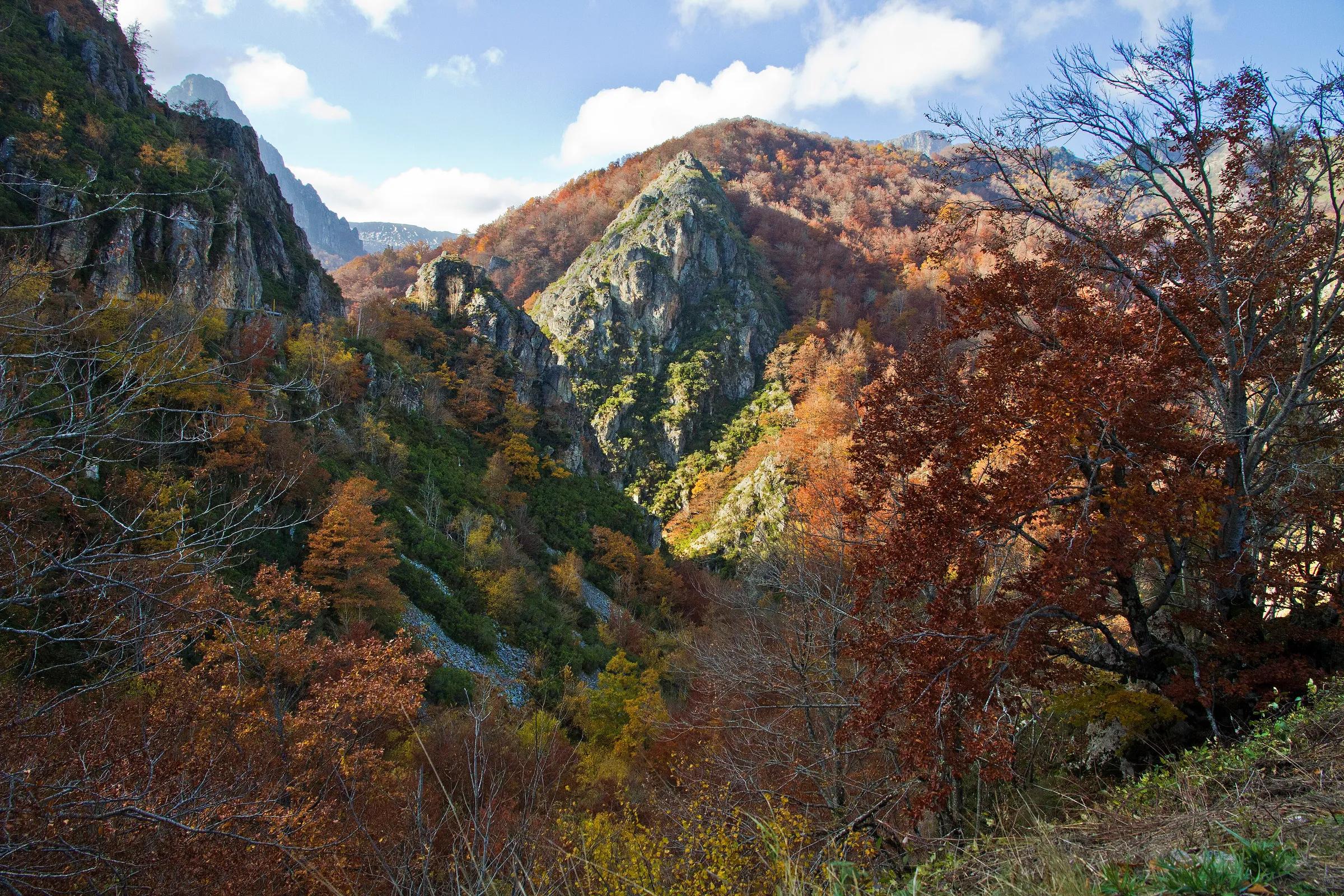
Beech
Fagus sylvatica
- Habitat
- The dominant tree of the mountain woods of Redes and Peloño, and of the higher slopes of Saja-Besaya.
- When
- Fresh green in spring; copper and gold from mid-autumn; its beechnuts feed bears and many other animals.
Saja-Besaya: oak below, beech above
In western Cantabria, the Saja-Besaya Natural Park spreads over 24,500 hectares of valleys and ridges. Spain's official tourism portal highlights its oak groves, beech woods and high pastures, naming the oaks around Bárcena Mayor and the oak and beech woods of Villasuso de Cieza. Roe deer and wild boar live here; wolves are present and brown bears are occasionally detected; griffon vultures and golden eagles ride the thermals and otters work the rivers. The park's visitor centre is in Saja, on the CA-280 road.
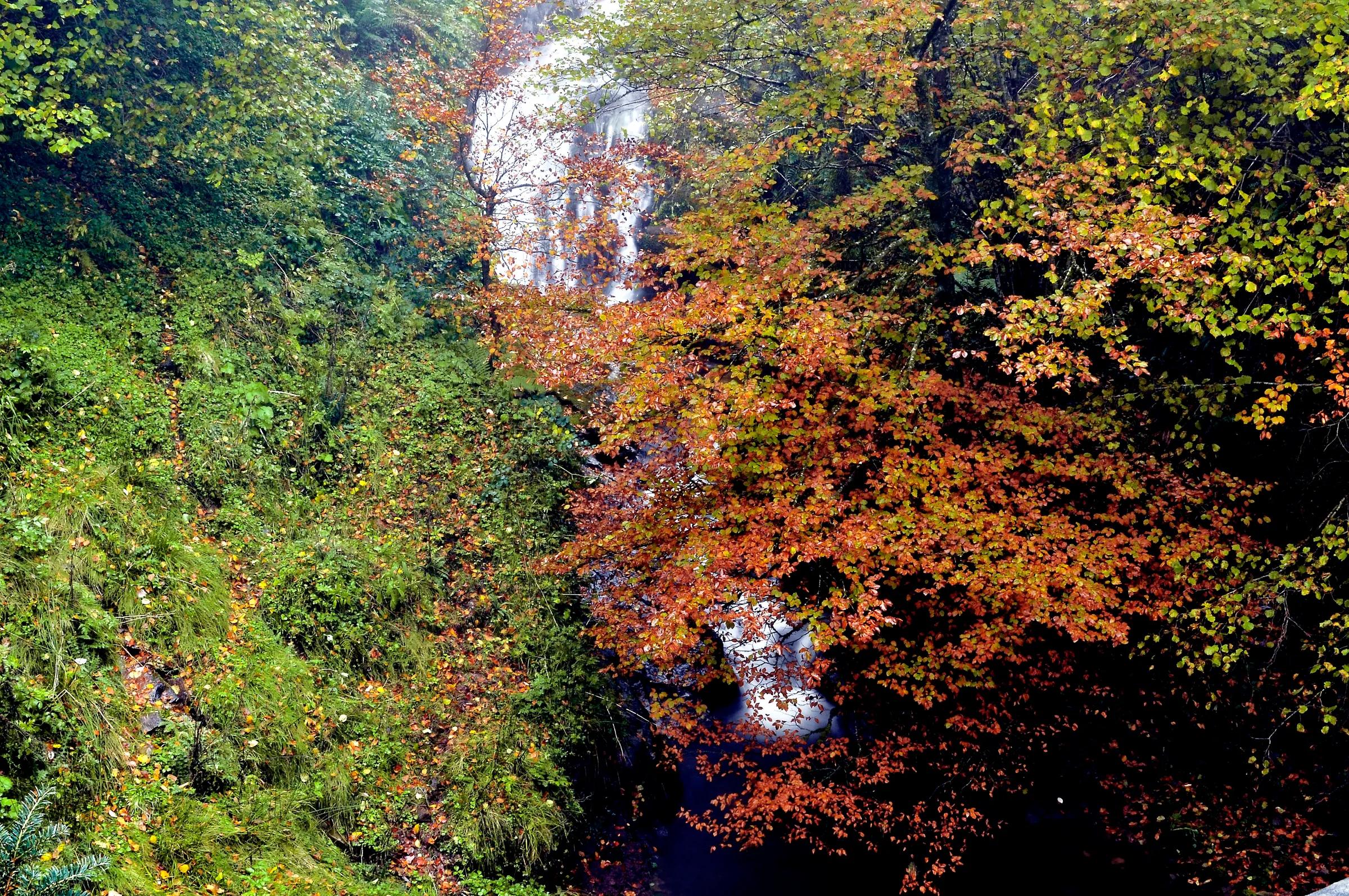
Muniellos: the oak wood behind a gate
Deep in the southwest of Asturias, in Cangas del Narcea, Muniellos is considered the largest oak forest in Spain and one of the most important in Europe. Oaks share the slopes with yews, maples and hazels, and brown bears, wolves, roe deer and even capercaillie live here. The Muniellos Biosphere Reserve takes in the Monte de Muniellos, La Vilieḷḷa and Valdebois.
Its protection is visible at the gate. Access is limited to twenty people a day and requires an official authorisation, which is free; only one permit is granted per person per year. Applications open on 15 December of the year before the visit, and the provisional authorisation must be confirmed between 23 and 15 days before the booked date. On the day you show the printed authorisation, or the PDF on your phone, together with your identity document. The visitor centre at Las Tablizas, where all three official routes begin and end, does not issue permits. The routes range from a 1.2-kilometre wooden boardwalk suited to people with reduced mobility and very young children to a long circuit of about twenty kilometres with difficult passages and steep slopes. Mobile coverage is poor.
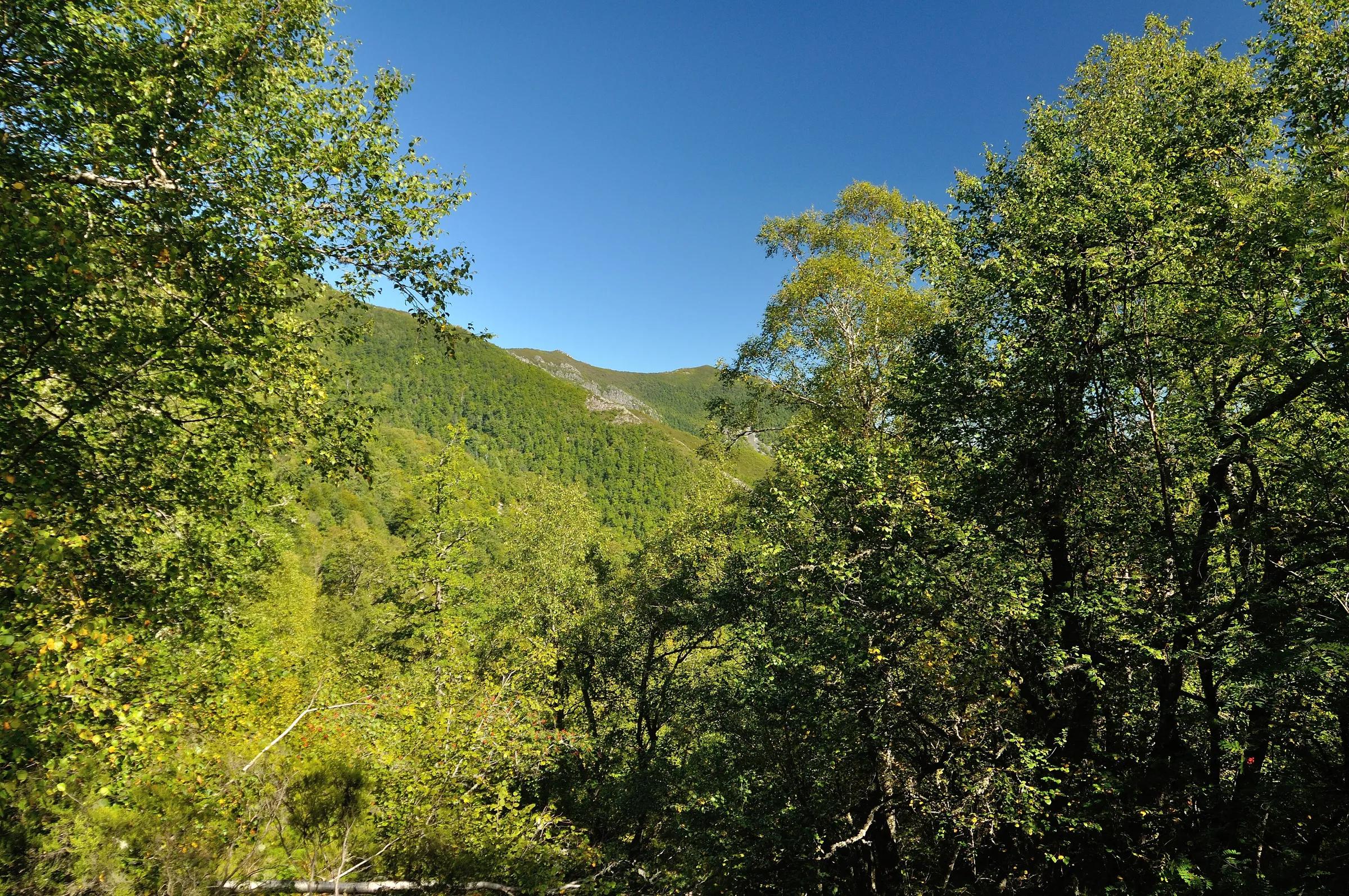
Oak
Quercus sp.
- Habitat
- The great oak wood of Muniellos; sessile oak also grows in patches in Redes and Peloño, and oaks clothe the lower slopes of Saja-Besaya.
- When
- All year; its acorns, with beechnuts, are the autumn fuel of the Cantabrian bear.
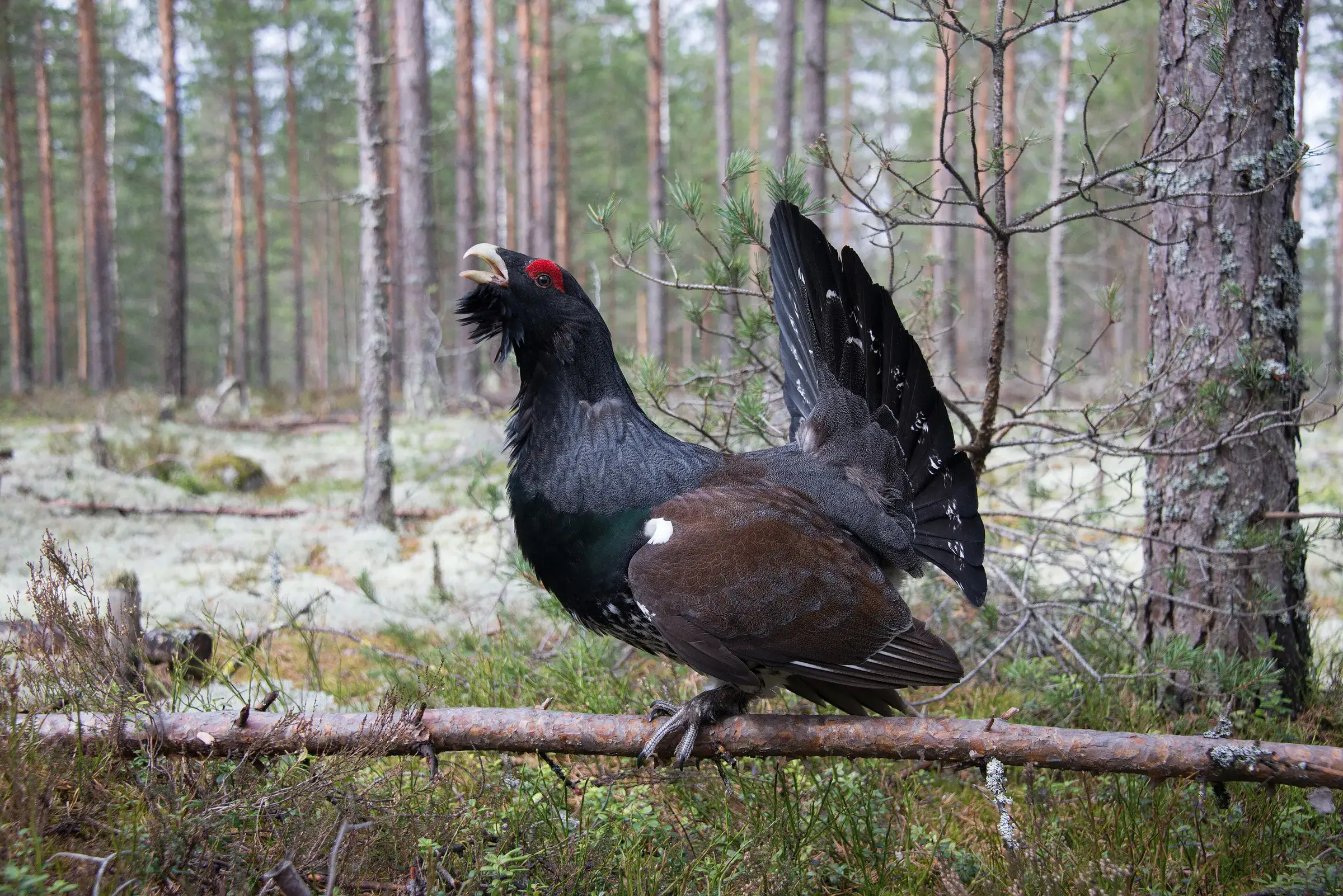
Capercaillie
Tetrao urogallus
- Habitat
- Listed by the official sources among the fauna of Muniellos and of the Redes Natural Park.
- When
- Rarely seen and easily disturbed: never seek out display grounds; leave it to the park staff and scientists.
Fragas do Eume: a river forest in Galicia
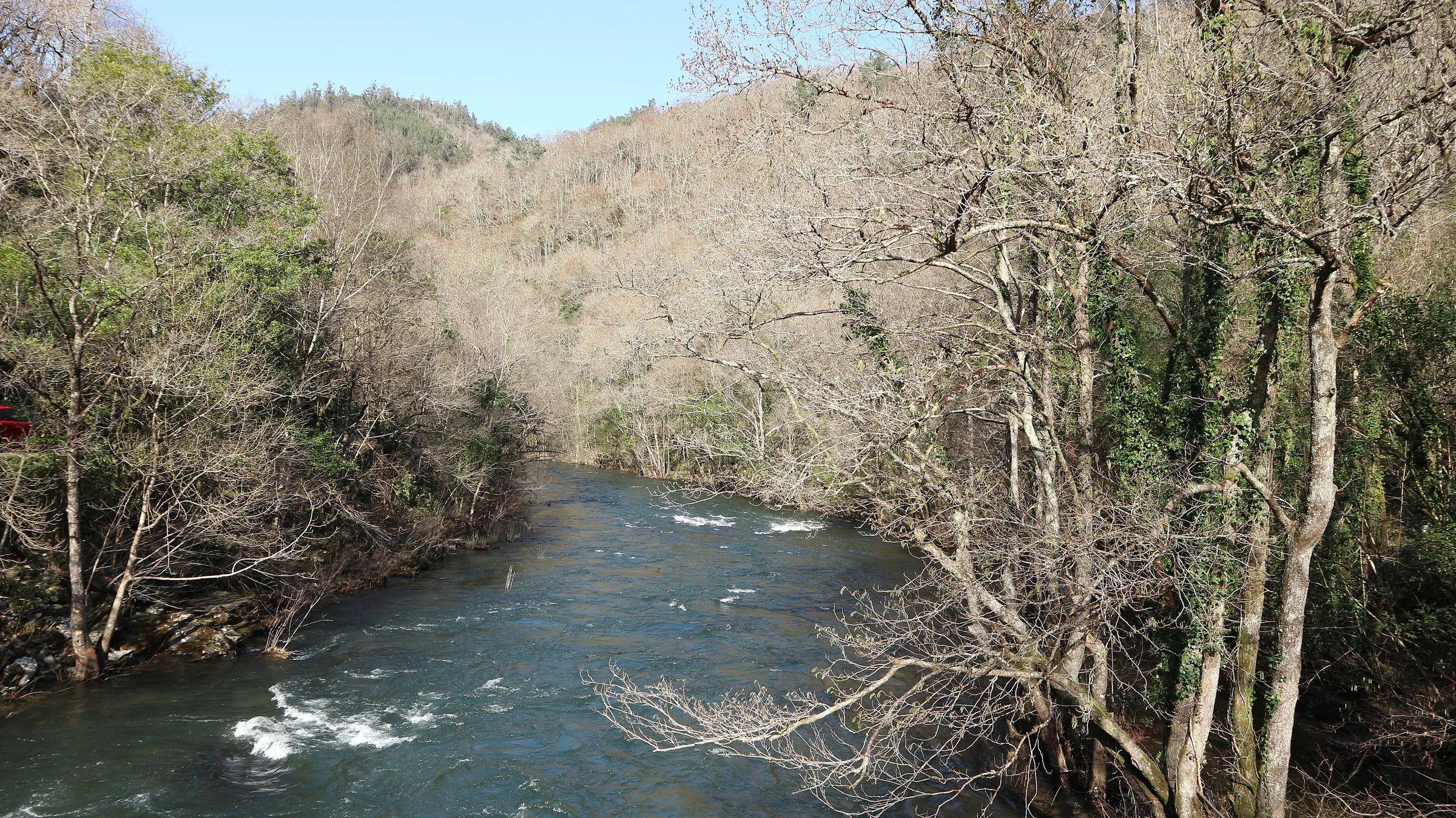
West, near the coast of A Coruña, the river Eume runs through what Turismo de Galicia calls one of the best-preserved riverside Atlantic forests in Europe. The natural park covers about 9,125 hectares. Oaks and chestnuts make up the deciduous canopy, with birch, alder, ash, yew, hazel, holly and strawberry tree beneath, and cork oaks on the south-facing slopes; lichens, mosses and ferns cover almost everything else. The park counts 103 species of birds, 41 of mammals and 8 of fish, as well as endemic invertebrates and reptiles.
Above the river stands the Benedictine monastery of San Xoán de Caaveiro, recently restored and a complete Romanesque monument, reached by a climb of about fifteen minutes from the A Figueira bridge. Turismo de Galicia notes restrictions on private vehicles on the park road at weekends, with public transport to the bridge, and says the best way to discover the park is on foot.
The seasons of a forest
Autumn is the famous season, and the official Peloño route names it as the best time to walk there: the beeches turn first, the oaks later, and the woods fill with fallen fruit that feeds the bear before winter. But each season has its own forest. Winter strips the Eume to its bones and lets you see the shape of the valley; spring brings a green so fresh it looks lit from inside, and the meadows of Arcenorio flower; summer is the time of deep shade, when a walk under beeches is several degrees cooler than the pasture outside.
Walking lightly
- Stay on the marked track. Old woods regenerate slowly, and trampled ground under beech takes years to recover.
- Carry out everything you bring in, organic waste included.
- Keep dogs on a lead, and give livestock and their guard dogs plenty of room.
- Leave fallen wood, fungi and moss where they are: they are the forest's larder and nursery.
- Keep your voice down. The animals you most want to see are the ones most easily disturbed.
- Respect permit systems and closures; they are why these woods are still here.
None of these forests is untouched. People have grazed, cut and walked through them for centuries, and the muleteers' track through Peloño is itself a piece of history. What makes them precious is continuity: the same soil, the same species, a web of life that has not been broken. A visitor's part in that is small and simple. Come slowly, take nothing, and leave the forest a little quieter than you found it.
Practical details checked on 8 November 2026. Rules, access and seasons change. Check the official sources below before you go.
Sources
- Turismo Asturias, Bosque de Peloño (ruta)checked 8 November 2026
- Turismo Asturias, Redes Natural Parkchecked 8 November 2026
- Spain.info (Turespaña), Saja-Besaya Natural Parkchecked 8 November 2026
- Turismo Asturias, Guía para visitar Muniellos(in Spanish)checked 8 November 2026
- Turismo de Galicia, Parque Natural Fragas do Eumechecked 8 November 2026
- Quercus, especial Fundación Oso Pardo (julio de 2026): frutos del bosque y dieta del osochecked 8 November 2026
Take it further
If this story set you thinking, here is where to take it next.
Series