
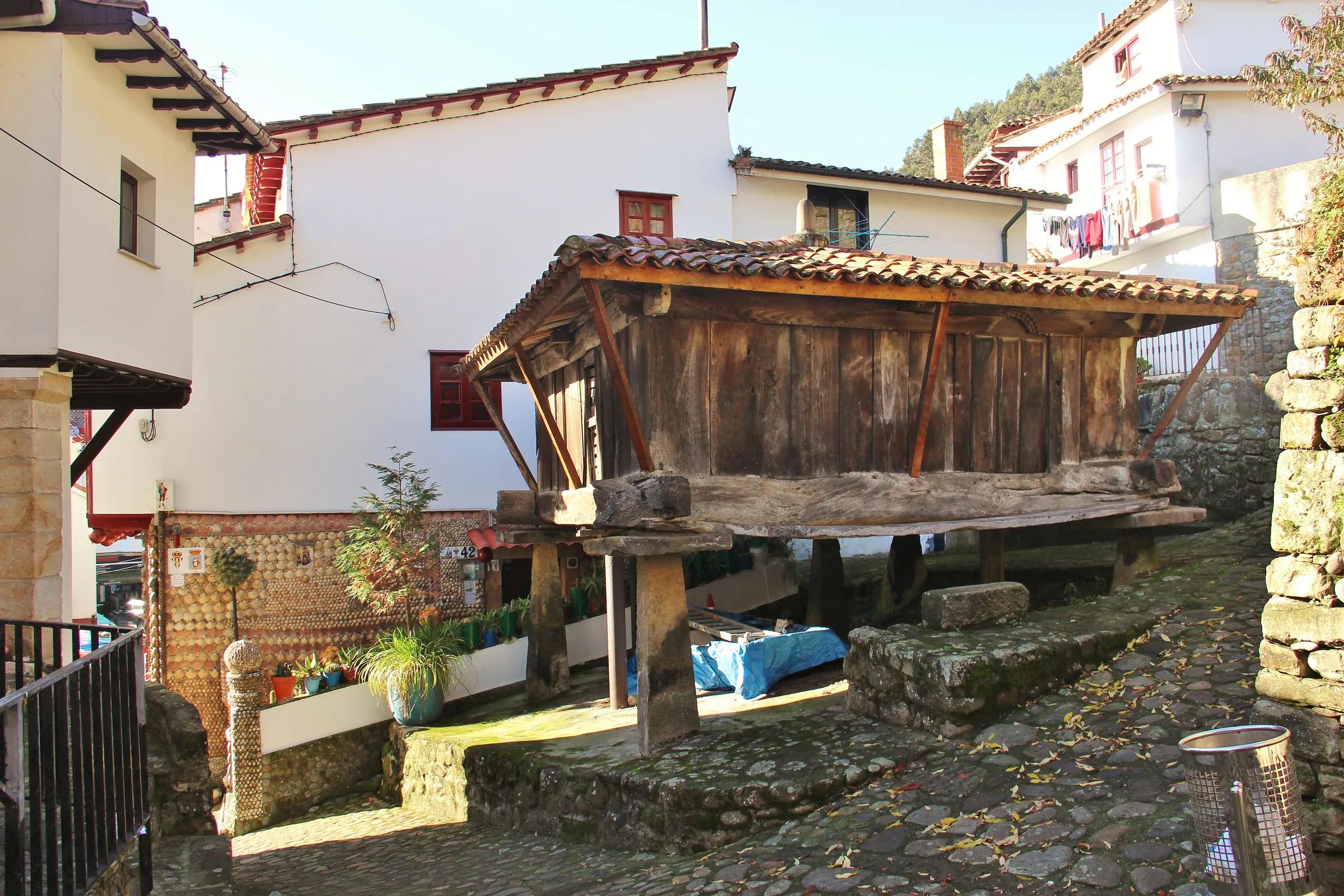
 Tubamirum / Wikimedia Commons, CC BY-SA 4.0
Life & Culture · Feature
Hórreos: the granaries of Asturias
Raised on stone legs, built without a metal nail and protected by law: how the hórreo and the panera came to stand beside so many Asturian houses, and where to see them.
In Tazones the houses crowd down towards the harbour, and among them, as if it had wandered in from the fields, stands a wooden room on stone legs. Its roof spreads wide; its walls are dark planks; beneath it, in the shade between the pillars, there is room for a cart, a stack of firewood, a few tools. Across Asturias this shape repeats itself beside farmhouses and village lanes, in valleys and on headlands, so familiar that it has become a kind of signature. It is the hórreo, and it was built to solve one problem: how to keep a harvest dry, and out of the mouths of rats, in one of the wettest corners of Europe.
Chapter oneA room for the harvest
The Principado de Asturias describes its hórreos and paneras as granaries built of chestnut and oak, raised on pillars and assembled with joints that can be taken apart. Their purpose is to preserve food from damp and from rodents. The oldest surviving hórreos date from the end of the fifteenth and the beginning of the sixteenth century, and they have been built ever since. The panera, a larger and longer version, appeared in the seventeenth century, at the same time as maize began to be grown widely in Asturias.
Maize changed the hórreo itself. The corredores, the wooden galleries that run around many granaries, were created mainly to dry and store maize cobs, and on some buildings they were added later, carried on extensions of the main beams. They became the place for ornament too: corridors are usually made with finer, more careful joinery than the rest of the granary, and many hórreos carry painted or carved decoration that the regional government calls unique examples of Asturian folk art.
Chapter twoPegollos, muelas and no nails
A hórreo stands on four elements, from the ground up. First come the pilpayos, flat slabs that carry the whole weight and keep ground damp away from the pillars. On them stand the pegollos, the tapering columns that support, balance and level the granary; depending on the area and the age of the building they are made of wood, a single block of stone or masonry. On top of each pegollo lies a muela, a horizontal slab of stone, square, round or irregular, that juts out far enough to stop rodents climbing up. A small wooden block, the taza, sits between the muela and the beam to level the frame and cushion the load.
The box above is a frame of heavy beams, the trabes, which span between three and five metres and often keep the shape of the trunk they were sawn from. Into them fit the colondras, the upright planks of the walls. Everything is held by traditional joints and wooden pegs. The regional guide to restoring hórreos puts it simply: these are prefabricated, mobile buildings, and to preserve the fact that they were designed to be dismantled, no metal nails or screws should be used, except for a few pieces of the corridors. Even the steps respect the rats. The stone stair, the subidoria, stops short of the granary, leaving a gap of forty to sixty centimetres that a person can step across and a rodent cannot.
Under the granary, the space between the pillars has its own name, the solorru: a sheltered corner for firewood, the cart and farm tools. The panera follows the same logic on a larger plan, standing on more pegollos; the central ones are set slightly lower to take the extra beam that a longer floor needs.
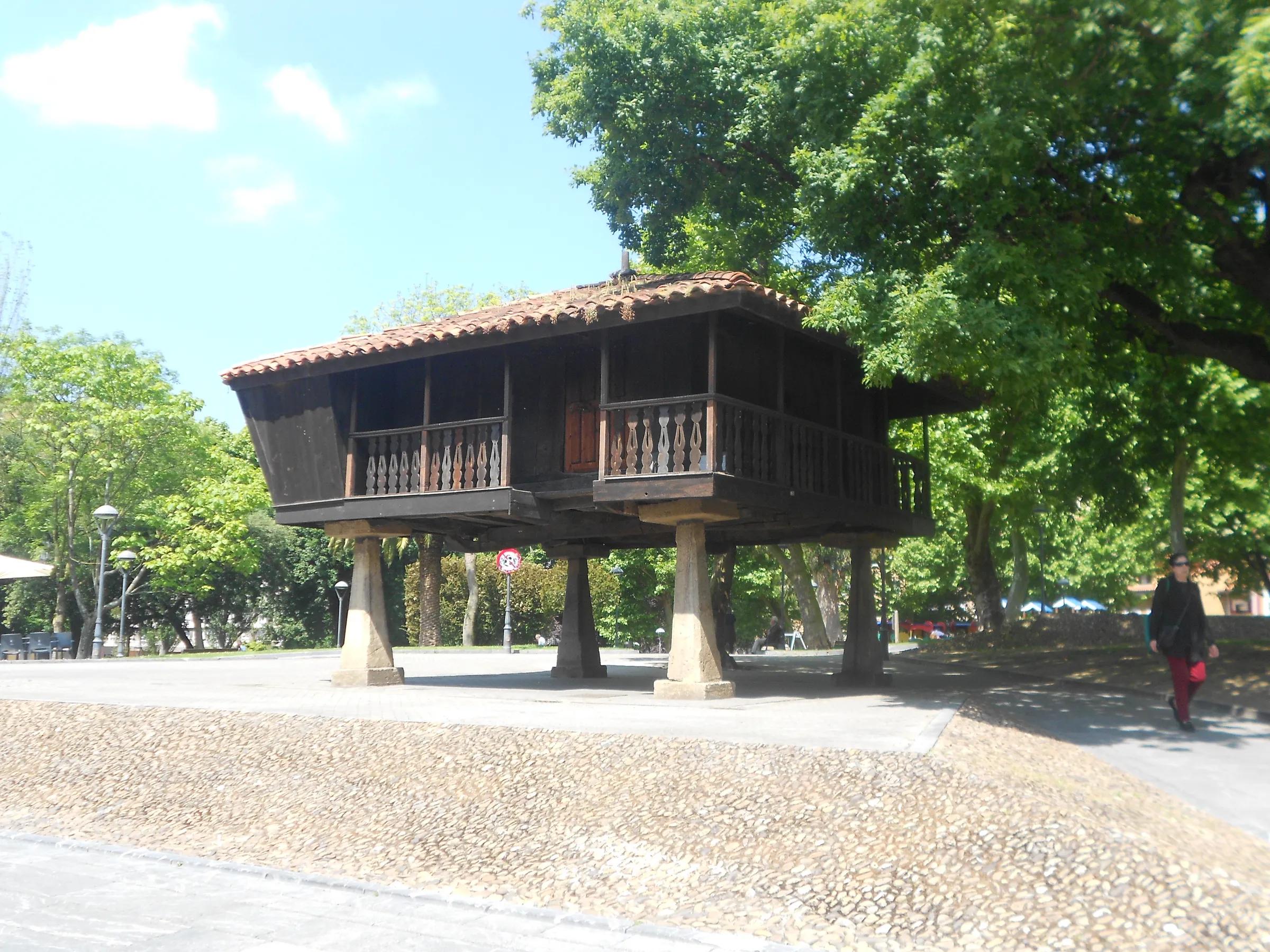 Bibliodepolvora / Wikimedia Commons, CC0 1.0
 Simon Burchell / Wikimedia Commons, CC BY-SA 4.0
Chapter threeOne idea, many roofs
Travel across Asturias and the granaries change their hats. The traditional roof is the curved clay tile, the so-called Arab tile, and some hórreos and paneras built in the first half of the twentieth century carry flat industrial tiles from Asturian works. In the west, slate roofs are the rule; Turismo Asturias points to Barcia, in Valdés, where the granaries stand under black slate. In the mountains of the far west survive the last thatched roofs, the teitos of rye straw, which the regional government describes as having been disappearing for decades. A roof of broom, the other kind of plant roof, survives on a single granary in the concejo of Somiedo, in the village of Urría.
Barcia also shows the third member of the family. Turismo Asturias counts 83 hórreos, 15 paneras and one cabazo there: the cabazo is another granary type of that western area, so one village holds the whole family.
Chapter fourProtected by law
Asturias protects its granaries in writing. Article 75 of the Cultural Heritage Law of the Principado, Law 1/2001 of 6 March, forbids building hórreos, paneras and cabazos detached from a dwelling, and requires new ones to follow the traditional materials and forms of their area. Its fourth paragraph reaches further. Even when they have not been declared a Bien de Interés Cultural or entered in the regional heritage inventory, hórreos built before 1900 that keep their construction features cannot be demolished, dismantled or moved without the authorisation of the regional ministry of culture. Nor may enclosures be built between their supports, or buildings attached to them, and the only works allowed on them are conservation and restoration with traditional materials.
A transitional provision of the same law places hórreos, paneras and cabazos built before 1940 that keep their traditional appearance under integral protection until each concejo approves its own heritage catalogue. The rules explain the patience you see on the ground: granaries repaired plank by plank, with old tiles reused and new wood left unvarnished, as the regional restoration guide asks.
Chapter fiveWhere to see them
You will see hórreos almost everywhere in rural Asturias, but some places gather them closely. In the Comarca de la Sidra, Turismo Asturias sends visitors to the fishing village of Tazones, and inland to Sietes, in Villaviciosa, where nearly thirty hórreos crowd the lanes. In Piloña, Espinaréu keeps almost thirty, most of them in good repair and still in use. Bueño, in Ribera de Arriba, has 47 and an interpretation centre devoted to the hórreo; Barcia, in Valdés, shows the slate-roofed granaries of the west.
Look closely and each granary tells you something: the stone of the pegollos, the size of the muelas, the joints of the trabes, a date or a rosette carved into a beam, a corridor hung with maize or with nothing at all. Five centuries after the first of them were raised, they still do what they were made for, and in the villages where they stand close together they say, more clearly than any sign, that this is Asturias.
Practical details checked on 8 November 2026. Rules, access and seasons change. Check the official sources below before you go.
Sources
- Principado de Asturias, Registro de soluciones técnicas tradicionales para el montaje de hórreos y paneras (2012)(in Spanish)checked 8 November 2026
- BOE, Ley 1/2001, de 6 de marzo, del Patrimonio Cultural (Asturias), texto consolidadochecked 8 November 2026
- Turismo Asturias, Pueblos para descubrir el mundo de los hórreos en Asturiaschecked 8 November 2026
- Turismo Asturias, Comarca de la Sidra (itinerario de turismo rural)checked 8 November 2026
Take it further
If this story set you thinking, here is where to take it next.
Series
In the series Eastern Asturias, closely
Life & Culture
Asturian cider culture
Places & Destinations
Cangas de Onís and Covadonga

Adventure & Outdoors
Canoeing the Sella
Journeys & Road Trips
Eastern Asturias, from the coast to the peaks
Life & Culture
Hórreos: the granaries of Asturias
Places & Destinations
Ribadesella, where the Sella meets the sea
Adventure & Outdoors
Walking the Cares gorge
Places & Destinations
Getting to the Lakes of Covadonga: how access works
Adventure & Outdoors
Reading the tide on the Llanes coast